Canada World Cup match day transit and walking backup checklist
Send morning of match. Practical checklist for international fans without cars to get to venue without meltdown. Evergreen process page for Canada.
Updated : 1 month ago
Canada World Cup match day transit and walking backup checklist
Canada World Cup match day transit and walking backup checklist is written for international fans without cars who need to get to venue without meltdown. If you have low patience for vague travel blogs, use this as an ops page: short decisions, red flags, and a checklist you can forward. We optimize for long-tail search and group-chat sharing — not for generic “ultimate guide” filler.
Context: primary focus is Canada. Rules, fees, and store policies change. Re-verify official sources the week you act. The URL is evergreen (no year in the slug) so you can reuse the process next season after a quick refresh.
Who this is for (and who can skip)
You will get value if you match this persona: international fans without cars. You are trying to get to venue without meltdown without learning every edge case the hard way. Skip this page if you already have a local expert handling everything and you do not need a shared checklist.
People who share this page usually need alignment inside a group: parents and students, couples, supporter friends, or coworkers on the same booking. A single shared checklist prevents three people from buying three incompatible options.
Why a narrow checklist beats generic tips
Generic “best tips for Canada” pages blur together. This one stays narrow on purpose: get to venue without meltdown. Specific failure modes are more useful than another broad list.
Beyond a three-bullet summary, you still need: it names failure modes, a shareable red-flag list, and a night-before sequence you can execute under stress.
Core decision framework
Start with the outcome that matters on the day: successfully get to venue without meltdown. Work backwards to the minimum information and objects you must have (IDs, screenshots, offline maps, backup payment). If a discount or shortcut removes a safety property — refundability, unlock status, passport compliance — price that risk explicitly.
Have a first choice and a backup if the first option fails in the first ten minutes. Groups that only invent a backup after failure lose money and time. Write the backup while you are calm.
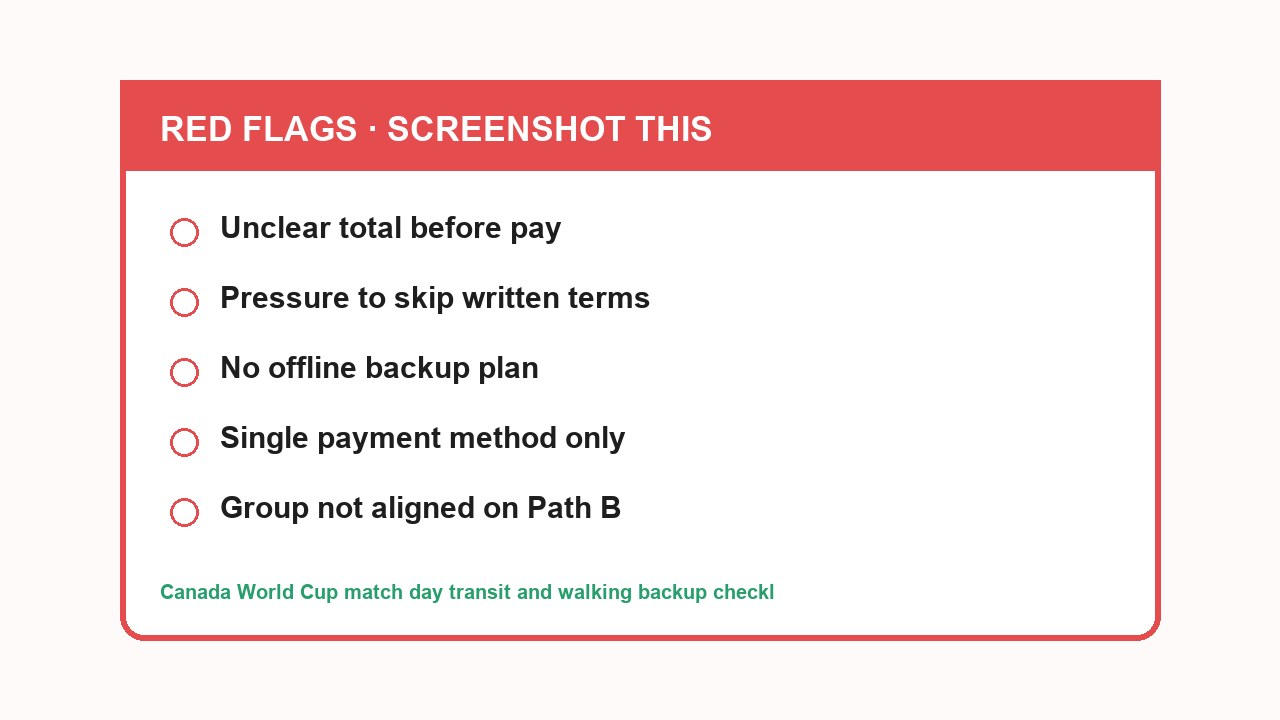
Red flags — stop before you pay
Step-by-step ops sequence
Night before: confirm times, screenshots, and who in your group owns each task. Pack physical IDs if required. Charge power banks. Download offline maps or tickets. Morning of: re-check disruption notices, store hours, and weather. At the moment of truth: if a red flag appears, switch to your backup plan instead of negotiating while adrenaline is high.
After success: save confirmations offline, photo serial numbers or room conditions when relevant, and drop a three-line note in the group chat so nobody double-books. After failure: write what broke in one sentence — that note is gold for the next day.
| Phase | Action | Owner tip |
|---|---|---|
| Night before | Screenshots + offline copies + roles | One person pins the thread |
| Morning of | Re-check live disruptions / hours | Do not trust yesterday’s memory |
| At decision | Run red-flag list before pay | Any “stop” ⇒ switch to backup |
| After | Save receipts; 3-line group note | Prevents double booking |
Checklist you can execute
- Primary + backup transit
- Offline maps
- Portable battery
- Agree exit meetup pin
- Backup payment method stored separately
- Group meetup pin if you split up
- Portable battery for maps and tickets
- Time buffer for queues and wrong entrances
- Screenshot this page’s red-flag box
Money, cards, and “gotcha totals”
Always compare the all-in total: base price, taxes, mandatory fees, FX, and the cost of a bad cancellation policy. A pretty headline rate that fails when plans move is more expensive than a flexible option with a slightly higher sticker. If a terminal offers dynamic currency conversion abroad, know your default: many travelers choose local currency with a fair card instead of tourist conversion — but follow your own bank’s math.
For Canada, keep one backup card offline from your primary wallet pouch. Fraud systems and travel notices still fail. The backup is part of the plan, not an afterthought.
Group-chat script (copy / paste)
Common failure stories (so you skip them)
Failure A: someone “remembers” a rule from a previous year that no longer matches the desk policy. Failure B: the group splits and each person buys a partial solution that does not compose. Failure C: payment works but documentation fails (missing ID, wrong name spelling, opened packaging, expired screenshot). All three are process failures, not bad luck.
If you are international fans without cars, assign a single “docs owner” for the day. That person holds the screenshots folder and confirms names match IDs before the queue, not during it.
Mini decision quiz
You hit a red flag mid-checkout but the discount is large. What should your group do?
Answer
Pause. Discounts do not cancel red flags. A backup plan exists so FOMO does not run the trip.
FAQ
Rideshare surge?
Expect it — leave early on transit.
Cash needed?
Carry a little; do not rely on one app.
Can I reuse this next year?
Yes — evergreen slug. Refresh live rules; keep the checklist process.
Is this official advice?
No. It is a consumer logistics checklist. Follow official sources and merchant terms.
What to re-check on official sources
Re-check hours, eligibility, fees, cancellation windows, and transport disruptions on official operator / store / government pages the week you go. This article is not a substitute for those sources. It is the shared process layer your group can execute together.
Bottom line
To get to venue without meltdown, run the red-flag list, keep a backup plan, and share one checklist with everyone who can spend money that day. That is how small sites help without publisher weight: clarity beats breadth.
For international fans without cars, the hidden cost is often coordination, not the sticker price. Ten minutes of shared planning removes an hour of argument in a queue. (Canada World Cup match — note 1.)
If children or less mobile travelers are in the group, add buffer to every walk and security line. Optimistic timelines are how people make desperate purchases. (Canada World Cup match — note 2.)
When two options are close in price, pick the one with clearer refunds and clearer documentation. Clarity compounds when something goes wrong. (Canada World Cup match — note 3.)
Keep a single shared album or folder for receipts and screenshots named by day and city. Future-you will not remember which chat had the PDF. (Canada World Cup match — note 4.)
If a local person offers to “handle it for a fee” outside official channels, treat that as a red flag unless you fully understand legitimacy and recourse. (Canada World Cup match — note 5.)
Weather, strikes, sold-out slots, and card declines are normal. Plans that only work on perfect days are not plans. (Canada World Cup match — note 6.)
Your backup plan should be specific: second store name, second route, second payment method — not “we will figure it out.” (Canada World Cup match — note 7.)
After the day ends, drop one improvement note for the next city on your trip. Checklists get sharper when groups iterate. (Canada World Cup match — note 8.)
For international fans without cars, the hidden cost is often coordination, not the sticker price. Ten minutes of shared planning removes an hour of argument in a queue. (Canada World Cup match — note 9.)
If children or less mobile travelers are in the group, add buffer to every walk and security line. Optimistic timelines are how people make desperate purchases. (Canada World Cup match — note 10.)
When two options are close in price, pick the one with clearer refunds and clearer documentation. Clarity compounds when something goes wrong. (Canada World Cup match — note 11.)
Keep a single shared album or folder for receipts and screenshots named by day and city. Future-you will not remember which chat had the PDF. (Canada World Cup match — note 12.)
If a local person offers to “handle it for a fee” outside official channels, treat that as a red flag unless you fully understand legitimacy and recourse. (Canada World Cup match — note 13.)
Weather, strikes, sold-out slots, and card declines are normal. Plans that only work on perfect days are not plans. (Canada World Cup match — note 14.)


